
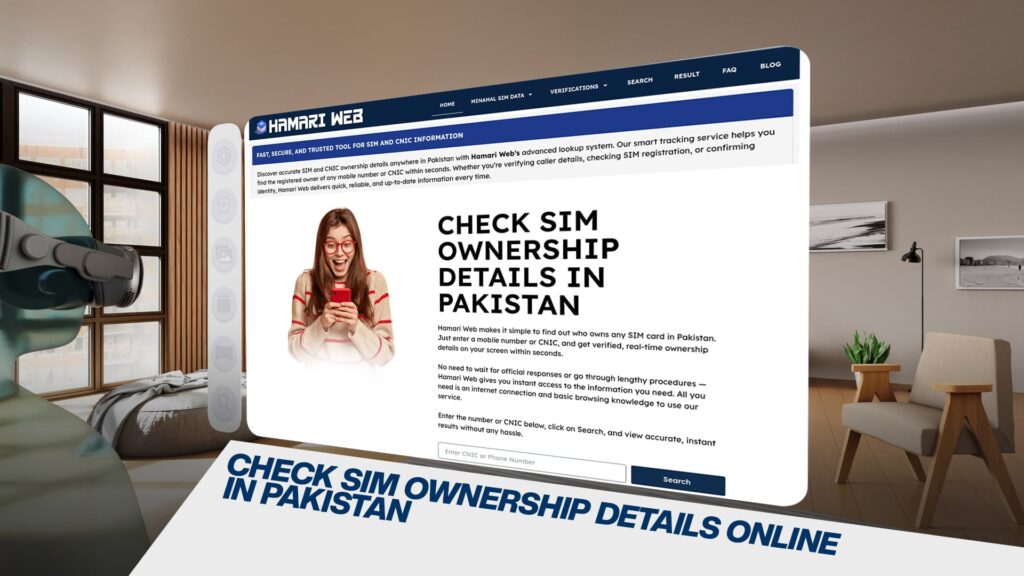
In today’s digitally connected Pakistan, your mobile number is more than just a contact point—it’s a vital link to your identity, finances, and personal security. With over 191 million mobile subscribers in the country, the need to verify SIM card ownership has never been more critical. Whether you’re receiving persistent calls from an unknown number, verifying a contact for a business transaction, or ensuring your own number isn’t misused, knowing how to check SIM ownership details is an essential skill for navigating modern life.
This is where Hamari Web steps in as a trusted national utility. Hamari Web is a free, dedicated online platform for Pakistani citizens to instantly and securely check SIM and CNIC ownership details. In a landscape where digital fraud, anonymous harassment, and identity theft are on the rise, having a legitimate, easy-to-use tool empowers you to take control of your telecom security. This comprehensive guide will walk you through everything you need to know about checking SIM ownership details online in Pakistan, using the Hamari Web service, understanding the legal framework, and adopting best practices for your digital safety.
Understanding SIM Registration and the PTA’s Role in Pakistan
To fully appreciate the service Hamari Web provides, one must first understand the robust regulatory framework behind it. The Pakistan Telecommunication Authority (PTA) is the federal government body mandated to regulate, facilitate, and oversee all telecommunication services in the country. In a significant move to bolster national security and create a traceable digital ecosystem, the PTA, in collaboration with the government, implemented a compulsory Biometric Verification System (BVS).
This system was rolled out as a cornerstone of the National Action Plan. It mandates that every new SIM card purchased in Pakistan—whether from Jazz, Zong, Telenor, Ufone, or any other licensed operator—must be registered against the subscriber’s 13-digit Computerized National Identity Card (CNIC) number. Crucially, this registration must be verified in-person through a biometric thumbprint scan at an authorized franchise or service center. This process directly links a physical identity to a digital number.
The primary objectives of this stringent system are multifaceted:
Enhancing National Security: The core aim is to eliminate anonymous and illegally registered SIM cards, which were historically misused for activities like extortion, terrorism coordination, and organized crime. A verified identity attached to every number makes the telecom network a hostile environment for malicious actors.
Strengthening Consumer Protection: By making every number traceable to an individual, the system empowers citizens and law enforcement. It helps reduce the menace of spam calls, fraudulent marketing, phishing attempts, and harassment, as perpetrators can be more easily identified and held accountable.
Building a Verified Digital Infrastructure: A securely identified user base is fundamental for the growth of digital services. It enables the safe expansion of mobile banking (like JazzCash and EasyPaisa), e-government services, and other digital authentication processes, as there is confidence in the identity behind the number.
This nationwide, centralized database, maintained with inputs from all mobile operators, is the technological foundation that makes public SIM ownership checks possible. When you use a service like Hamari Web, it acts as a secure, user-friendly gateway to query this publicly accessible layer of information, presenting the legally disclosable details to you in a simple, readable format within seconds.
Why Checking SIM Ownership Details is a Necessity in Modern Pakistan
The reasons for verifying a SIM owner are diverse and often stem from practical, everyday concerns faced by millions. It’s a tool for personal security and due diligence. Here are the most common and pressing scenarios where this check becomes invaluable:
Identifying Unknown and Harassing Callers: Persistent calls from an unfamiliar number can range from a minor annoyance to a source of significant anxiety and threat. A quick check can reveal the registered name, helping you determine if it’s a telemarketer, a forgotten contact, a legitimate business, or a potential scammer. This knowledge informs your decision to block, report, or answer the call.
Verifying Contacts for Business and Financial Transactions: In an era of freelance work, online buying and selling (on platforms like OLX or Facebook Marketplace), and digital payments, it’s prudent to verify new contacts. Before sending an advance payment, sharing sensitive documents, or finalizing a deal, confirming that the mobile number is registered to the person claiming it adds a critical layer of trust and security to the transaction.
Investigating Fraud, Scams, or Cyber Harassment: If you receive threatening calls, phishing attempts pretending to be from banks or government agencies, or blackmail messages, knowing the registered owner of the number is the first concrete step. This information is essential when filing a formal complaint with the Federal Investigation Agency’s (FIA) Cyber Crime Wing or when reporting the incident to your mobile network operator for action.
Performing a Personal Security Audit: Checking Your Own CNIC’s SIM Ownership: This is arguably the most important proactive use of the service. Citizens can and should check how many SIMs are actively registered under their own CNIC number. This audit can reveal fraudulent SIMs obtained using forged copies of your identity card, which could be used for illicit activities in your name, potentially implicating you in legal issues.
Verifying Second-Hand or Recycled Mobile Numbers: When purchasing a used or prepaid number that is being recycled by an operator, checking its registration history can provide peace of mind, ensuring it is not associated with a problematic past.
Parental Control and Safeguarding: Parents can verify numbers that are frequently contacting their children to ensure they are communicating with known individuals and to identify potential risks from strangers.
Introducing Hamari Web – Pakistan’s Free and Accessible Verification Portal
In response to this widespread public need for easy access to verification tools, Hamari Web has emerged as a leading, user-centric platform. It successfully bridges the gap between the official PTA database and the everyday citizen, demystifying the process.
What exactly is Hamari Web?
Hamari Web is a comprehensive Pakistani online information portal that hosts a dedicated, specialized tool for checking SIM ownership details linked to a CNIC, and conversely, checking all SIMs registered under a specific CNIC. It is designed with the explicit goal of serving the Pakistani public, emphasizing simplicity, instant access, and security without bureaucratic hurdles.
Key Features and Benefits of the Hamari Web SIM Check Service:
Completely Free of Cost: The service operates without any hidden charges, subscription fees, or premium tiers. It is a genuine public utility offered at zero cost.
No Registration or Login Required: Privacy is respected from the start. You do not need to create an account, share your email address, or provide any personal data just to use the verification tool. This also makes the process remarkably fast.
Instant, Real-Time Results: The query process is optimized for speed. Once you enter the required number, the system fetches data and delivers results within a few seconds, providing immediate answers.
High Security and Privacy: The platform acts as a secure intermediary. It does not store, log, or misuse the query data you input. Its function is to facilitate a lookup, not to build databases on users.
Exceptionally Simple Interface: The tool is designed for universal accessibility, catering to users of all technical skill levels. Clear instructions and straightforward input fields (for either the mobile number or CNIC) guide you through the effortless process.
Comprehensive and Cross-Network Data: It fetches information from the centralized database that includes records from all major mobile operators (Jazz, Zong, Telenor, Ufone), giving you a complete and unified picture rather than a single-network view.
A Detailed, Step-by-Step Guide: How to Check SIM Owner Details on Hamari Web
Using Hamari Web is a deliberately straightforward process, designed to be accessible to everyone. Here is a detailed breakdown of both primary methods:
Method One: Checking the Registered Owner of a Specific Mobile Number
This method is used when you have a specific 11-digit number you wish to investigate.
Access the Platform: Open your preferred web browser on any device—a smartphone, tablet, laptop, or desktop computer.
Navigate to the Tool: Go to the Hamari Web website. You can use a search engine like Google and search for “Hamari Web SIM owner details” to find the direct link. On the site, locate the section or tool specifically labeled ‘SIM Owner Details’ or ‘Check SIM Owner’.
Enter the Mobile Number: On the tool’s page, you will see a clearly marked input field. Carefully enter the complete 11-digit Pakistani mobile number you wish to check. The standard format is 03XXXXXXXXX (e.g., 03151234567). Ensure you have the correct number to avoid errors.
Initiate the Search: Click on the “Search,” “Check Details,” or similarly labeled button. The system will now process your query.
View the Results: Within moments, the results will be displayed on your screen. The information will typically include two key pieces of data: the registered owner’s full name (as per the CNIC) and the mobile network operator (e.g., Jazz, Zong, Telenor, Ufone) to which the number is currently subscribed.
Method Two: Checking All SIMs Registered Under Your CNIC (Personal Audit)
This is a crucial proactive security check for every citizen.
Find the Correct Tool: On the Hamari Web platform, navigate to the tool often called ‘CNIC SIM Details’, ‘Check SIMs on CNIC’, or something similar. It is usually separate from the single-number check tool.
Input Your CNIC Number: In the provided field, enter your 13-digit CNIC number. Do not use dashes or spaces; input it as a continuous string of numbers (e.g., 4220112345671). Double-check for accuracy.
Run the Audit: Click the search button to submit your query.
Review the Comprehensive List: The system will generate and display a list showing all active mobile numbers (spanning across all telecom operators) that are currently registered under the provided CNIC number. This list is your personal telecom footprint and is essential for identifying any fraudulent subscriptions.
Important Privacy Note: In compliance with Pakistani regulations and privacy norms, the service is designed to disclose only the information necessary for verification and security purposes. It will show the registered holder’s name and operator. Other sensitive personal details like the full home address, family information, exact location data, or NICOP details are not part of the public record and are therefore not disclosed by Hamari Web. This maintains a responsible balance between public security and individual privacy.
Understanding and Correctly Interpreting Your Search Results
Knowing what the results mean is as important as obtaining them. Here’s how to interpret the information Hamari Web provides:
A Confirmed Name and Network: A successful search that returns a name and operator confirms a verified link between that specific mobile number and a Pakistani national identity. This verification empowers your next decision. For an unknown caller, it tells you who is associated with the number. For a business contact, it confirms their claimed identity. This is the primary goal of the check.
Encountering a “No Details Found” or Error Message: Do not be immediately alarmed if you see this. It can occur for several technical and practical reasons:
The mobile number may be inactive, recently disconnected, or suspended.
It could potentially be an unregistered or illegal SIM (which itself is a red flag and may warrant reporting to PTA if the calls are malicious).
There might be a temporary delay or glitch in the synchronization between the operator databases and the central system, especially for very newly activated numbers.
In rare cases, a data entry error during registration could cause a mismatch.
Multiple SIMs Listed Under a Single CNIC: The PTA has set a reasonable limit on the number of SIMs one person can hold across all networks. If your personal audit reveals an unusually high number (e.g., 10, 15, or more active SIMs) under your name that you did not personally register, this is a major red flag indicating potential identity theft and fraud.
The Critical Importance of Regularly Auditing Your Own CNIC
Proactive vigilance is the most effective defense against identity-based telecom fraud. We strongly recommend that every Pakistani citizen perform a personal CNIC audit via Hamari Web at least once every six months. Treat it like a financial health check-up. Here’s a deeper look at why this habit is non-negotiable:
To Actively Prevent Identity Theft: Criminals can use lost, stolen, or photocopied CNICs with forged fingerprints to fraudulently obtain SIMs in your name. These “ghost SIMs” can then be used as untraceable tools for criminal activities, financial fraud, or social media defamation, all while the legal trail leads back to you.
To Safeguard Your Financial Security: A significant portion of banking fraud, including unauthorized transactions and OTP (One-Time Password) theft, is facilitated through illegally registered SIMs. By gaining control of a number in your name, a fraudster can intercept banking SMS alerts and OTPs, bypassing a key security layer.
For Your Own Legal Protection: If a SIM registered under your name is used in any criminal activity—from threatening calls to coordination of illegal acts—you may be called in for questioning by law enforcement. Having a record of your regular audits, showing you reported unknown numbers, can serve as evidence of your vigilance and victim status.
Step-by-Step Action Plan if You Find a Fraudulent SIM: If your Hamari Web audit reveals an unknown, suspicious number registered to your CNIC, take immediate and systematic action:
Step 1: Note down the full number and the network operator shown.
Step 2: Immediately contact the customer service helpline of that specific mobile operator (e.g., Jazz, Zong). Report that a SIM has been fraudulently registered on your CNIC without your knowledge or consent and demand its immediate block and disconnection.
Step 3: File an official complaint with the Pakistan Telecommunication Authority (PTA). You can do this by calling the PTA helpline at 0800-25625 or by submitting a complaint through the official PTA website.
Step 4: For serious cases involving threats, blackmail, or financial loss, file a formal First Information Report (FIR) or complaint with the Federal Investigation Agency’s (FIA) Cyber Crime Circle in your city. Provide them with all the evidence, including your Hamari Web audit results.
Legal and Ethical Use of SIM Ownership Information
Hamari Web provides a powerful tool for public good, and with that power comes significant responsibility. It is imperative for every user to employ this information strictly within ethical and legal boundaries as defined by Pakistani law, including the Prevention of Electronic Crimes Act (PECA).
Permitted and Responsible Uses: Verification for personal security, fraud prevention, parental control, auditing your own data, and conducting due diligence for legitimate business transactions.
Strictly Prohibited and Illegal Uses: Using the information for harassment, stalking, intimidation, sending unsolicited marketing, blackmail, personal vendettas, or any action that infringes upon another person’s privacy and safety. Misusing personal information is a serious offense and can lead to severe legal consequences, including fines and imprisonment under PECA.
A Note on Data Privacy and Platform Integrity: Reputable platforms like Hamari Web are carefully designed to provide only the necessary information required for verification and security purposes. They operate within the legal framework and do not facilitate or encourage the invasion of deep privacy. Users should be wary of any other service that promises overly detailed personal data, as such services may be illegal or scams themselves.
Addressing Common Concerns, Limitations, and Alternative Methods
Users often have questions about the scope and reliability of the service. Let’s address them clearly:
Is using Hamari Web legal? Yes. The platform accesses the publicly allowable layer of information from the official PTA-mandated database, which exists for the purposes of transparency, security, and consumer empowerment. It functions similarly to operator-owned verification services but in a more user-friendly, consolidated manner.
Is the information 100% accurate? The data is pulled directly from the operator’s official records. Its accuracy is therefore dependent on the integrity of those original records. If a SIM was registered using a expertly forged CNIC, the displayed name will be that of the forger (as per the fake document). The system verifies the registration data, not the ultimate truth of the subscriber’s identity beyond the submitted documents.
Can I check international or landline numbers? No. This service is specifically designed for Pakistani mobile numbers (03XXXXXXXXX) registered with licensed Pakistani cellular operators. It does not work for international numbers (+92…) or PTCL landlines.
What if the Hamari Web website is slow or temporarily down? High user traffic can sometimes cause slowdowns. As a reliable alternative, you can use the official PTA 8484 service. Simply type your CNIC number (without dashes) and send it via SMS to the shortcode 8484. You will receive an official SMS reply from your operator listing all SIMs registered under your CNIC. This is a direct, government-sanctioned method.
Complementary Tools and Best Practices for Complete Digital Safety
While Hamari Web is an excellent tool for verification, true digital safety requires a layered approach. Combine its use with these complementary tools and prudent habits:
Leverage the Official PTA Channels: Beyond the *8484* service, download the official ‘PTA Mobile Verification’ App from your phone’s app store. This invaluable app allows you to scan or enter the IMEI number of any mobile phone to check if it is reported as stolen or blocked by PTA—a vital check when buying a used handset.
Use Call-Blocking and Identification Apps Wisely: Applications like Truecaller can provide crowdsourced caller ID information. However, use them with caution regarding the permissions you grant and be aware that their data is user-generated and not officially verified like the PTA database.
Practice Fundamental Digital Hygiene: Never, under any circumstances, share your mobile banking PINs, OTPs, or CNIC photocopies with untrusted parties. No legitimate bank or government institution will call you to ask for your ATM PIN or full OTP.
Report Actively and Promptly: Don’t just block and forget. Report harassing, threatening, or scam numbers to your network operator (who can block them at the network level) and, for serious offenses, to the FIA Cyber Crime Wing. Your reports make the network safer for everyone.
Educate Your Circle: Share knowledge about tools like Hamari Web and the importance of CNIC audits with family members, especially those who are less tech-savvy and more vulnerable to phone-based scams.
The Future of Digital Verification and Security in Pakistan
The digital verification landscape in Pakistan is not static; it is continuously evolving to meet new challenges. The PTA has already implemented advanced systems like the Device Identification Registration and Blocking System (DIRBS), which blocks stolen or non-compliant phones at the network level. Future advancements may include even more secure multi-factor biometrics and integration with other national databases.
Hamari Web is likely to adapt and expand their role within this evolving framework. We may see them offering more holistic digital identity verification services, potentially integrating (where legally permissible) checks for other types of registrations, providing a more comprehensive one-stop security audit for citizens. The direction is clear: towards a more secure, transparent, and user-empowered digital Pakistan.
Yes, it is completely and genuinely free. Hamari Web is a free public information portal, and its SIM ownership check tool does not require any payment, subscription, or hidden fees at any stage. You can use it as many times as you need without any cost, making it accessible to everyone.
No, and this is by design to protect privacy. Due to strict privacy regulations and ethical guidelines, the service only reveals the publicly allowable information necessary for verification. This includes the registered full name of the SIM owner and their mobile network operator. Sensitive personal details like home address, exact location, family information, or other CNIC data are not disclosed publicly.
This indicates potential identity theft. Take immediate action: First, contact the customer service helpline of the relevant mobile operator (Jazz, Zong, Telenor, etc.) shown in the results to report the fraudulent SIM and request its immediate blockage. Second, file a formal complaint with the Pakistan Telecommunication Authority (PTA) via their helpline (0800-25625) or website. This creates an official record and helps clean your digital identity.
This message can appear for several legitimate reasons: The mobile number may be inactive, recently disconnected, or not yet fully activated in the central database. It could also be an illegal, unregistered SIM. Occasionally, temporary technical delays in database updates between operators and the central system can also cause this. It does not necessarily mean the number is fake, but it does mean no verified registration record is currently accessible.
For robust personal security, it is highly recommended to perform a self-audit at least once every six months. Consider doing it quarterly if you are active online. This regular check-up helps you quickly identify and address any fraudulent SIM activity linked to your identity, protecting you from potential legal, financial, and reputational harm. It is a simple habit with significant protective benefits.
Conclusion: Empowerment Through Verified Information
In a world where our digital and physical identities are inextricably linked, information is not just power—it is protection. The ability to check SIM ownership details online for free is not merely a technical convenience; it is a fundamental tool for personal security and a reflection of a maturing digital society. Hamari Web, by providing instant, free, and secure access to this verified information, democratizes safety and puts crucial control back into the hands of the Pakistani citizen.
By making it a habitual practice to verify unknown contacts, conduct regular personal CNIC audits, and use this information responsibly, you do more than just protect yourself. You contribute to the collective security of the nation’s digital ecosystem, making it harder for criminals to operate anonymously. Stay vigilant, stay informed, and use trusted tools like Hamari Web responsibly to navigate the digital world with confidence and peace of mind.